deanandlinda.com

Dean and Linda’s Blog

Archive for the ‘Food and Wine’ Category

Icelandic Hakarl

with one comment

Per the trusted Wikipedia source, Hakarl is fermented shark.  The reason it is fermented is because the shark itself is poisonous when fresh due to a high content of uric acid and trimethylamine oxide (aka urine).

Yum.

The reason I know this is we returned from Iceland about 3 hours ago and some people in Iceland consider Hakarl a food.

As background for the uninitiated, Hákarl is traditionally prepared by gutting and beheading a Greenland or basking shark and placing it in a shallow hole dug in gravelly-sand, with the now-cleaned cavity resting on a slight hill. The shark is then covered with sand and gravel, and stones are then placed on top of the sand in order to press the shark. The fluids from the shark are in this way pressed out of the body. The shark ferments for 6-12 weeks depending on the season in this fashion.

Following this curing period, the shark is then cut into strips and hung to dry for several months. During this drying period a brown crust will develop, which is removed prior to cutting the shark into small pieces and serving. The modern method is just to press the shark’s meat in a large drained plastic container.

First-timers are sometimes advised to pinch their nose while taking the first bite as the smell is much stronger than the taste. It is often eaten with a shot of the local spirit, a type of akvavit. Eating hákarl is often associated with hardiness and strength.

Those new to it will usually gag involuntarily on the first attempt to eat it due to the high ammonia content.

We had not read this last part before our trip, but a picture (or series of pictures) is worth a thousand words.

Written by dean

February 9th, 2009 at 10:38 pm

Pho

without comments

An Introduction to Pho

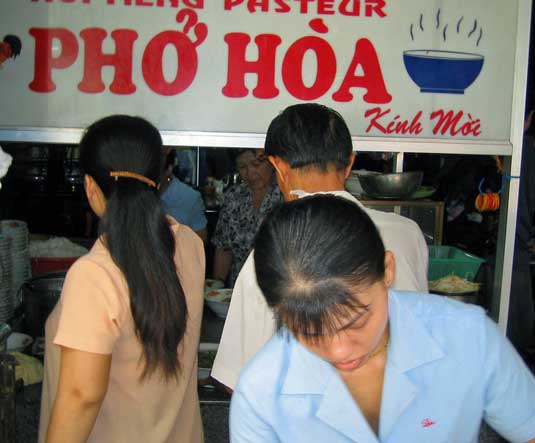
We love to eat pho, a Vietnamese beef noodle soup.  We had pho for the first time (not surprisingly) in Ho Chi Minh City, Vietnam.  We sampled the dish at a few different restaurants, our favorite being Pho Hoa.  I have since returned once and hands down, this is the best pho I have ever had.

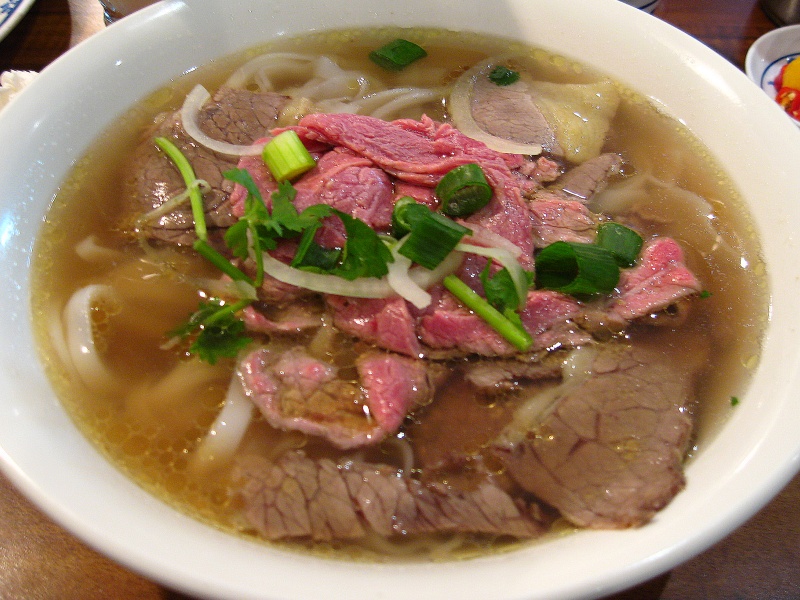
Leveraging content from Wikipedia, pho consists of white rice noodles in clear beef broth, with thin cuts of beef (steak, fatty flank, lean flank, brisket).  This is all served in a bowl.  The broth is generally made by simmering for several hours a collection of beef bones, oxtails, flank steak, charred onion, and spices. Seasonings include Saigon cinnamon, star anise, charred ginger, cloves, and sometimes black cardamom pods.  The noodles, called bánh pho in Vietnamese, are traditionally cut from wide sheets of fresh rice noodles, although dried noodles (also called “rice sticks”) are also used (frequently in the US, based on our experience).  A bowl of pho is garnished with a combination of green onions, white onions, coriander leaves (cilantro), ngò gai (culantro, or long coriander), Thai basil, lemon or lime wedges, and bean sprouts. Several of these items are served on the side, along with fish sauce and a collection of hot spices and peppers, so you can concoct your own bowl based on personal preferences.

We eat pho tai, which is pho with thin slices of rare eye of round.  The slices are thin enough that the hot broth cooks them through.  Broth, noodles and sides are standard – variations (and names) are based on variations in meat content, which can include tendons and organ meats if you are so inclined.

A surprisingly thorough history of pho, including a recipie, is found at Vietworld Kitchen.  We have not tried this recipie having concluded from prior (largely successful) attempts at homemade pho that it is easier and cheaper to go to a restaurant (expect $5 to $6 per bowl).  Recipies generally result in 4-6 quarts of broth – that makes a lot of pho – far too much for 2 people.  For those that do not live within a 15 minute walk of several pho joints, invite some friends and give the recipie a go.  Keys are paraboiling the bones, star anise, fish sauce, slightly freezing the meat so it is easy to slice thinly, and using fresh noodles if you can find them.

Our Continuing Pho Journey

Upon return to Chicago in 2006, we scoped out local Pho restaurants.  Linda has a cousin from Vietnam (no joke but an extended story) who had a few suggestions and took Linda to lunch one day when I was out of town.  Chicago has several immigrant neighborhoods – including 2 Vietnamese areas plus a variety of Asian ethnic groups in and around Chinatown.  We had two regulars in Chicago – Pho Hoa (review) on Broadway between Lawrence and Argyle and, nearby, Pho Xe Tang (Tank Noodle Restaurant – review), on the corner of Broadway and Argyle.  Both are good – I found the broth at Tank Noodle to be more flavorful – but we did not really frequent one more than the other.

Pho in New York is superior in quality and flavor.  My all-around favorite is Cong Ly (review) on the corner of Chrystie and Hester on the Lower East Side / Chinatown.  Debating pho is a dicey proposition, especially as a non-Vietnamese.   My point of view is that there are 5 basic pho evaluation criteria – the broth, the noodles, the meat, the sides, and the ambiance of the restaurant.

Almost every Pho restaurant I’ve been to is a dump – floorescent lights, formica tables, and tile floor – so they all score evenly on this criteria (our favorite in Vietnam has no windows).  Definately not a first date kind of place.  The sides are consistent – bean sprouts, fresh basil leaves, fish sauce, hot sauce, and hot peppers.  Variations include the freshness of the sides, soy sauce (on the table or not) and lime versus lemon.  My wife informs me that in Vietnam (and Asia), pho is served with a kaffir lime, that kaffir limes are not widely available in the US (or are expensive), and that lemons are frequently recommended as the closest readily available alternative.  I don’t use either, but the distinction is important to Linda.

The big difference between noddles is fresh versus dried.  Thin, fresh rice noodle makes a positive difference.  Broth may be the most important item and is partly personal preference – I tend to prefer a meaty broth with a noticeable star anise flavor.  Who knew I liked star anise?

Cong Ly has flavorful broth, fresh noodles, and good meat (quality and quantity) – and a particularly dreary ambiance.  So far tops in our domestic quest.

Since we eat pho almost every week, in addition to Cong Ly, we have a few regular destinations here in New York.  Pho Grand (review) is closest to our apartment.  On a good day, this place has the best broth, though quality varies between average to very good.  Similarly, the quality and quantity of meat varies.  Noodles are Pho Grand’s downfall – consistantly average (dried).  Inconsistency aside, at worst Pho Grand has good Pho and some days it is <arguably> the best in town.

Also good is Pho Bang (review), where we frequented most regularly before finding Cong Ly.  This is probably our second choice.  Pho Bang is dependable, has the best noodles, the freshest sides and is Linda’s favorite as a result.  The broth is consistent but lacks the flavor of Cong Ly or (on a good day) Pho Bang.  Again, the differences are slight between the three restaurants, and if you don’t eat 52 bowls of pho a year, will likely be undetectable.

If you have a personal favorite in the United States, please share.  Off this morning for a bowl of pho.

Written by dean

October 4th, 2008 at 10:03 am

Posted in Food and Wine

Faking Orgasm

with 3 comments

Have you ever seen the movie When Harry met Sally? You know that scene where Harry and Sally are in a deli and Sally is telling Harry about fake orgasm, then she fakes one herself to show him? That scene takes place at Katz’s Deli in New York.

The first thing on the menu at Katz’s is the pastrami sandwich. And when you eat there, you should get the pastrami sandwich. Unfortunately no one told Sally to have the pastrami. If she had been eating the pastrami, she would not have had to fake her orgasm- and you won’t either.

At Katz’s the corn beef is good, the French fries are good and the pickles- locally made and aged to different degrees are terrific. But the pastrami is what you should eat. You can order pastrami for $22.80 per lb from Katz’s website: www.katzdeli.com though I can’t imagine it could be as good as when they slice it for you while you wait. In fact, if you order at the counter, the give you some of the edge pieces to eat while they make your sandwich – the pastrami is so good that some people can’t even wait until they sit down to start eating it.

The sandwiches are expensive – $14. They are also big, you really only need to eat half but you will want to eat the whole thing.

Katz’s delis is located at 205 Houston St. It is five small blocks from our apartment.

Photo by Greg Bakes

Written by linda

October 13th, 2007 at 1:44 pm

Posted in Food and Wine,Linda

French Bordeaux and America’s Constitution

with one comment

Since there have not been any recent posts, you may be wondering what we have been doing. We have been drinking and we have been reading.

Sometimes, I do read things other than The Economist. We are daily subscribers to the Chicago Tribune. We get the Sunday New York Times delivered to our door. I read Playboy for the articles, jokes, and – let’s be honest – the lovely pictures. Until recently, I had not been traveling as much as usual. Airplane time is generally personal time for me, so the more I travel the more time I have to read.

constitutionWhen is the last time you read the Constitution of the United States? While it only takes about 25 minutes to read the Constitution, it took me quite a bit longer to complete Akhil Reed Amar’s America’s Constitution: A Biography. The 477 page biography PLUS 150 pages of notes proved a bit more challenging than expected, but the first few chapters aside, this was an enjoyable book. There was interesting and thoughtful analysis of the impact slavery had on the development of our country. It is equally remarkable how little the document has changed over more than 200 years. Recommended. I have always enjoyed history, and completed an excellent biography of John Adams in 2005. I feel more knowledgeable having read America’s Constitution.

Reading a 600 page biography of the US constitution, however, is not something you do over a beer. It requires more sophisticated refreshments. My bourbon addiction is well chronicled and was well matched to the book, though unfortunately sourced from a former slave state – I’ve never seen a Land of Lincoln bourbon. A less obvious match is French Bordeaux. Remember that is was the French who both sponsored the Revolution and sold us large chunks of land as we expanded westward.

Bordeaux Primer

Time has expanded my knowledge of wine, though French wine has proven a challenge over the years. The real reason for the recent Bordeaux binge is that 2005 had great weather in many of France’s wine growing regions – cool and wet at the beginning so the grapes grow fat, hot and dry at the end so the grapes shrivel up and concentrate the fruit. In anticipation of this great vintage, I resumed effort on deciphering French wine. Purists will not be impressed with my analysis. To educate myself, I buy a lot of wine and use The Oxford Companion to Wine as a reference.

Common to pretty much all wine is the vintner (who makes the wine) and the vintage (the year the grapes were harvested). Technically, vintner means wine merchant – who sells the wine – which isn’t necessarily the same as who makes the wine. Just like a single factory can make a VCR sold by both Sony and Toshiba, a single wine producer can sell their wine via different brands. We will ignore this – it is the same VCR regardless of the label. Vintage is important because the weather plays a large role in the quality of the wine – this is no surprise if you think about it – wine is basically an agriculture product. Some years are better than other years, as any farmer will tell you.

Two other important pieces of information are the type of grape used to make the wine and where these grapes are grown. While this is standard information, the main difference between US and French wine is how this information is communicated.

In many areas of the world, including the United States, wine is often named by the primary grape – Merlot, Cabernet, and Shiraz are all types of grapes frequently used to make wine. Just like at the supermarket, some grapes are red and some grapes are white. The type of grape reveals a lot about the wine. Drink enough wine made from different types of grapes, and you can develop an understanding of what types of wine you enjoy based on the grape. A common question at a wine store is ‘What type of wine are you looking for – Merlot, Cabernet, Chardonnay?’

Drink even more wine and you develop an appreciation not only for what types of grapes you like, but where your favorite type of grape is grown. Syrah grapes are grown all over the world (called Shiraz in Australia) – drink enough Syrah / Shiraz and you can taste the common differences. Just like at the supermarket, you can get a Florida red grapefruit or one of those wonderful Ruby Red grapefruit from Texas – both red grapefruit but I know which one I buy. Geographic information is almost always found on the wine’s label.

As an example, last night we had a bottle of 2003 (Vintage) L’Ecole No. 41 (Vintner) Cabernet Savignon (type of grape) from the Walla Walla Valley (where the grapes were grown). The Walla Walla Valley is a popular wine growing region in Washington State.

The basic challenge with French wine is that the type of grape is generally not provided explicitly on the label. The reason is that in France, where the wine is from almost always communicates the type of grape as well. An elaborate history of Government-controlled categorization supports this classification system. Champagne, for example, is actually a region in France that produces a lot of – surprise – champagne. Other regions that may sound familiar are Bordeaux, Languedoc, Beaujolais, and Cotes du Rhone. Because I haven’t memorized the types of grapes grown in each of France’s wine growing regions, I carry a cheat-sheet.

Bordeaux is one, important wine growing region and home to approximately 13,000 vintners across 247,000 acres (about 400 square miles). The region is further subdivided into appellations. Most Bordeaux wines are blends of Cabernet and Merlot grapes, with a few additional varieties of various types. Bordeaux is basically separated by the Gironde River. Knowing if one of the 37 appellations is on the ‘left bank’ or the ‘right bank’ of the river is suggestive of the predominate grape. Appellations Saint Emilion and Pomerol generally produce predominately Merlot-based wines, while Appellations Margaux and Pauillac generally produce Cabernet-based wines. Just like knowing I live in Chicago is useful information, knowing I live in Chicago’s Gold Coast neighborhood is even more useful.

As an example, I am planning to drink a 2003 Chateau Vray Croix de Gay Pomerol Bordeaux. Chateau Vray Croix de Gay made the wine from predominantly Merlot grapes grown in 2003 in the Pomerol area of the Bordeaux region. Piece of cake once you have a cheat sheet.

China

bonesAs this post suggests, I’ve probably been doing more wine drinking than book reading, though I did finish another excellent book, Oracle Bones by Peter Hessler. This is more of a beer book – ‘wo yao yi bing ping Tsing Tao pi jio’ (I want 1 cold bottle Tsing Tao beer). Prior to moving to China, I read several books on Chinese business etiquette and what I could expect living in China. None of these books prepared me in any way for living and working in China. I like to think that had Oracle Bones been published in 2004, this would have been a superior read in preparation for an assignment in China. Certainly after the fact, the book is full of ‘yes, that is exactly what it is like’ moments that only an American in China would fully appreciate, but that even a novice should be able to comprehend. If you’ve been to China or are planning a trip to China, read this book.

Written by dean

October 1st, 2006 at 5:57 pm

Posted in Dean,Food and Wine

My Chicago Vegetable Market

with one comment

One thing I love about summer in Chicago are our vegetable markets. Farmers from Michigan drive up early on Saturday’s and set up their produce.

Every year there seem to be new additions, small farms selling beef or dairies selling cheeses. There’s even a truck that pulls up and sells bulk spices.

Herbs are terrific, plentiful, and so much better than the small plastic boxed ones from the grocery. Except for the basil, which is very good but sells out quickly in the early weeks. In the five or so weeks they have been open this summer, this week was the first time I was able to get basil. I just don’t get up early enough. This week the basil I bought was so gorgeous I put it in a vase in the kitchen. When it started to wilt, I just could bring myself to bag it, and put the whole vase in the refrigerator. I know odors in the refrigerator are not good, but when I open the door, the basil smells great. I don’t think I’ll mind if the fruit I eat this week tastes a little basil-ish. I’m not sure what I’m going to do with the basil – it was a true impulse purchase.

I love to stand by the herb stand and just look and smell the fresh herbs.

I also bought cherries this week. They were very delicious and I ate them all, just out of the bag.

And flowers. I like to buy flowers for our bathrooms and our living room. This week I bought lavender for my bathroom. I know its not a flower, but it smelled good. And this was also the first week for gladiolas. Dean loves glads and he will request them every single week as long as they are available. This week our choice was red and yellow and they are coming into bloom right now, in my living room.

Written by linda

July 31st, 2006 at 5:25 pm

Posted in Food and Wine,Linda

By Popular Demand – Linda’s Recipies

without comments

Ma Po Dou Fu – Pock Marked Mother Chen’s Bean Curd

plentyAs our Chinese friends know, and many agree, this is the ultimate dish in Shanghai and Beijing. I never liked tofu until I came to China. Now I adore it. This is also the first Chinese dish I crave. In Shanghai, sometimes this dish is called Ma La Duo Fu.

In China, I had several recipes for this dish, none were any good. Now, thanks to Fuchsia Dunlop I can make it. She is a Sichuan (Szechwan) goddess. Her book Land of Plenty is entertaining and good. It would be 100% worth every penny just for this recipe.

Fuchsia recommends a sprinkling of ground beef, but we use ground pork as we are certain that’s what we liked in Shanghai. We also like to serve this American style, on rice.

1 block bean curd (trust me – you need soft, not silken tofu, not extra firm either)
4 baby leeks (I use green onions- this recipe really wants Chinese onions, which look like green onions and are much stronger- but they are generally not available in Chicago)
½ C peanut oil
6 oz ground beef (we use ground pork)
2 ½ TBSP Sichuan chili bean paste (I bought this in China, but it is available in my Chinese market here, another name according to Fuchsia is dou ban jiang).
1 TBSP fermented black beans
2 TBSP ground Sichuan chilies (in Shanghai, ground Sichuan pepper is readily available, I bought lots of the kind made by McCormicks)
1 cup stock (I use whatever kind we have)
1 tsp white sugar
2 tsp light soy sauce
4 TBSP cornstarch mixed with 6 TBSP cornstarch
½ tsp ground roasted Sichuan pepper

I roast the peppercorns then grind them up some. I think in China they use them whole. I also add dry Sichuan peppers cut and their seeds to the skillet then roast them too. I have not seen these peppers in the US, I think they are important in China, but Fuchsia knows they are hard to get so she does not list them.

Cut the bean curd into 1-inch cubes and leave to steep in very hot or gently simmering water that you have lightly salted. Slice the leeks at a steep angle into thin “horse ear” slices 1 √Ç¬Ω inches long.

Season the wok, then add the peanut oil and heat over a high flame until smoking. Add the minced beef and stir fry until it is crispy and a little brown, but not yet dry.

Turn the heat down to medium, add the chili bean paste and stir-fry for about 30 seconds, until the oil is a rich red color. Add the fermented black beans and ground chilies and stir-fry for an additional 20-30 seconds until they are both fragrant add the chilies have added their color to the oil.

Pour in the stock, stir well and add the drained bean curd. Mix it gently by pushing the back of your ladle or wok scoop gently from the edges to the center of the wok – do not stir or the bean curd may break up. Season with sugar, a couple of tsp of soy sauce and salt to taste. Simmer for about 5 minutes, until the bean curd has absorbed the flavors of the sauce.

Add the leeks or scallions and gently stir in. When they are just cooked, add the cornstarch mixture in two or three stages, mixing well until the sauce has thickened enough to cling glossily to the meat and bean curd. Don’t add more than you need. Finally, pour everything into a deep bowl, scatter with the ground Sichuan pepper and serve.

Note regarding Sichuan Peppercorns – when we were living in China, we read the FDA prohibited importation of these due to a “Citrus Canker” experienced by orange trees. Recently, according to the Chicago Tribune, this ban has been lifted.

Linda’s Mushroom Lasagna

From The Cucina Bella Cookbook by Mark Donaway & Susan Shafer.

This recipe is simple but time consuming. I generally prepare the ingredients the day before when we plan to serve this at a dinner party. I think you probably need to allow at least four hours to make this.

The recipe comes from a Chicago restaurant called Cucina Bella. Once at least five years ago, we went to dinner there and ate at a kitchen table with some friends. We were not familiar with this restaurant, but our friends were discriminant diners and really recommended it. The mushroom lasagna was so good I bought the cookbook to get the recipe. Luckily, I talked to the chef before buying the book and he told me the secret ingredient for mushroom lasagna – mushroom soy sauce. The recipe in the book only includes mushroom soy sauce in mushroom cream sauce, not in the lasagna recipe, but I add it anyway – it is a secret ingredient. You can buy mushroom soy sauce in Asian markets and it is actually a secret ingredient anytime you cook with mushrooms√¢‚Ǩ¬

If you can’t get the mushroom soy sauce, and you should seek it out – trust me. At least add some regular soy sauce. It won’t be as good but it will be better than nothing.

Ingredients:

3 ½ lb portabella mushrooms (stems removed & chopped fine, caps slices ¼ inch think)
1 white onion (diced thin)
1 oz olive oil
1 oz lemon juice
3 oz flour
2 lb spinach

1 ½ lb grater provolone
1 lb Ricotta
½ lb grated Parmesan
20 oz lasagna noodles (uncooked) – I always use cooked noodles
3 oz unsalted butter
2 √Ç¬Ω quarts of heavy whipping cream (trust me – 2 quarts is PLENTY!)

2 TBSP mushroom soy sauce

In a large pan, heat olive oil and slowly cook onions. Add mushroom caps and cook on low for 45 minutes. This is important. Cook the onions 10 – 15 minutes, then really cook the mushroom stems at least 45. Remove mixture to food processor, grind and set aside.

Using the same pan, cook the mushrooms caps until tender (4-5 minutes). Set aside.

Using a heavy pot, reduce lemon juice by 1/2. Add butter and flour to make a light mix. Add heavy cream, reduce heat and still occasionally until the juice has dissolved. Add ground mixture and the mushroom soy sauce and cook for 45 minutes on low heat. Salt and pepper to taste.

This sauce will be so delicious by the time you finish, that you will consider not even making lasagna, just eating it yourself with a spoon. If you have any left over, it will be delicious on noodles.

To assemble the lasagna: In a lasagna pan layer the raw lasagna noodles. Place spinach, cheeses, mushroom caps and sauce in layers. Continue this process, remembering to save some cheeses for the top. Cover with aluminum foil. Bake for 45 minutes at 450. Remove foil and brown cheese on the top for 10 minutes. Let sit at least 10 minutes so you don’t burn yourself.

Slice and serve hot. Serves 8 – 10. Also makes great leftovers.

Linda’s Spring rolls

From Cuisine Magazine, Issue #13, Jan/Feb 1999

Cuisine recommends either of two types of wraps – spring roll wrappers or rice paper. I have a DRAMATIC preference for the rice paper wraps. The look and taste better. You are going to go to a lot of trouble to make these, make them good.

Makes about 14 rolls

Ingredients
Soy Sauce
Brown sugar
Rice vinegar
Sesame oil
Cornstarch
Garlic
Ginger
8 oz pork loin
14 small shrimp
1 sweet potato
1 bunch cellophane noodles
cider vinegar
rice roll sheets – get twice as many as you need for breaks and mistakes
1 ½ C shiitake mushrooms
Napa cabbage
1 leek
cilantro

Combine marinade ingredients
For the marinade combine:
¼ C soy sauce
2 T brown sugar
1 T rice vinegar
2 T sesame oil
1 ½ T cornstarch
1 T garlic minced
1 T ginger minced

Add:
8 oz pork loin cut in 2 X ¼ strips

Let stand 15 minutes. Stir fry pork with marinade over medium heat until no longer pink. Let cool.

Blanch and drain:
2 c sweet potato, grated
Blanch shredded sweet potato in boiling water for 2 minutes. Rinse with cold water and drain. Spread on paper towel lined plate to continue drying.

Blanch and halve lengthwise:
14 small shrimp
Peel shrimp. Plunge into boiling water for 1 ½ minutes, until cooked. Drain and let cool. Halve shrimp lengthwise and remove any veins. Set aside.

Soak and drain
1 bunch cellophane noodles
Soak dried noodles in boiling water for 15 minutes. Drain well and cut into short pieces with scissors.

Mushrooms
Remove stems from mushrooms and slice caps into strips.

Cabbage
Shred leafy parts of cabbage into thin strips with a knife.

Leeks
Halve leeks lengthwise and cut into 2″ pieces then julienne pieces.

Cilantro
Pick out 14 nice cilantro leaves from the bundle. Pinch the leaves off the stem.

Keep rice papers in package until you are ready so they don’t curl.
Soak rice papers one at a time in 2 C hot water and ¼ C cider vinegar

Place softened sheet on a damp towel. Put a second sheet in liquid. Arrange fillings, except shrimp and cilantro, on the bottom edge of the softened sheet.

Pull the sheet over the filling. Tuck edges under the filling as you go up. Roll the sheet halfway up then arrange 2 shrimp halves and 1 cilantro leaf top-side down on rice sheet.

Fold sides of the rice paper in to enclose the filling. This will allow the shrimp and cilantro to show through.

Finish rolling. Place finished rolls seam-side down on a tray that has been lined with damp paper towels. Cover with damp paper towels.

I use two sauces:
One with half soy sauce and half rice vinegar. I shake in some red pepper flakes.

A second with SiRaCha a red Chinese sauce with a chicken on the bottle and a green top. Put some rice vinegar in a bowl, squirt in the sauce to taste and mix.

The actual recipe calls for the following Thai peanut sauce:

Combine and bring to a boil
½ C hoisin sauce
½ C creamy peanut butter
½ C low-sodium chicken broth
3 T light soy sauce
3 T honey
2 T garlic, minced
2 T ginger, minced
2 T sesame oil
2 T red wine vinegar
1 T sugar
1 T chili sauce with garlic

Written by linda

June 18th, 2006 at 1:08 pm

Posted in Food and Wine,Linda

What We Are Drinking

with one comment

margaux One joy of living in Chicago again is having access to excellent wine. Certainly we have access to poor wine as well, but the quality and variety of wine available in the USA exceeds that available in China by such a wide margin that the two are incomparable. We did not drink much wine in China since the selection was so disappointing in relation to the price. Also, beer is 50 cents a quart.

Linda and I visited the wine cellar over the weekend, rearranged the contents, added some new bottles, and brought some old bottles home. New to our stash is the 2002 Chateau Lascombes Margaux, a very good wine from what I understand was a difficult grape growing season in France. Good with cheese and red meat – we have tested it with both filet mignon and hamburger and quite enjoyed both combinations.

fincaOne of the better bottles I’ve had in a while made its way to our cellar from Spain. The 2003 Finca Sandoval from the Manchuela region is a great tasting wine – 80% Syrah, 9% Mourvedre, 7% Bobal, and 4% Tempranillo. This and a 2002 Box Stallion Pinot Noir I had during a trip to Melbourne, Australia earlier in the year are the two most enjoyable wines I’ve had in many months. I have not figured out how to acquire the Box Stallion in the USA.

Cheers.

Written by dean

April 5th, 2006 at 6:40 pm

Posted in Dean,Food and Wine

Updates

without comments

2001 Tignanello

Delivered safely by UPS and locked securely in our wine cellar by the fine folks at The LockUp. Linda confirmed delivery and said she didn’t drink any. I will double-check in December.

In the original post, I also failed to note that our wine cellar is not new to the Antinori family. Several bottles of Antinori Peppoli (a Chianti) happily reside with us, too.

Text / HTML Editor

This post was written using the free version of NoteTab. I plan to upgrade to NoteTab Standard for US$9.95. The standard version basically adds a spell checker. The text editor functions are fine – it has a nice tabbed interface which is useful for keeping open multiple documents.

There is also an HTML library with a ‘highlight and click’ function to quickly add HTML tags (i.e. text formating and such). I formatted most of this post directly in NoteTab as opposed to the WordPress text editing facility.

Thumbs up.

Ayi or Ayis

Still not clear so, for the purposes of www.deanandlinda.com, ayi is both the singular and plural form of ayi.

According to my tutor, my initial analysis of the different ways to describe a collection of ayi in Chinese was generally correct. My tutor, Fan Hang Ying, agreed that the ‘few’ or ‘many’ structure was acceptable (few ayi or many ayi) and also suggested the concept of an ayi ‘group’ – ayi men.

My building has a group of ayi = ‘wo de hao lou you ayi men.’

There has been much discussion about the fact that my ayi is male and therefore not technically an ayi. Fu wu yuan (kind of like helper, I guess – used most frequently for a waitress / waiter) and nan ayi (male ayi). Opinion seems divided, so since he introduced himself as ‘ayi’ I will call him ayi.

Cascading Style Sheets

I still have not received my CSS / XHTML book – I expect it this week. My vision for the photo page layout needs to be explored further. From the WordPress Codex (aka help guide), I have educated myself to the point of waiting for the book.

A WordPress page is made up of ‘parts’ – a header, a body, a footer, etc. Within a broad set of rules, you can have many different parts, all of which are highly customizable. Each part is basically a file (*.php) that describes layout and formating rules. The parts are ‘glued’ together by a style sheet (style.css) – I previously edited my style sheet to allow for basic picture formating.

To do what I want, I just need to (a) add a new part called something like picturepage.php, (b) figure out how to set the layout and formating rules I want for the new part, (c) add this new part to the style sheet, and (d) identify the rules for how to tell WordPress when to use the picturepage part versus the regularpage part.

It’s all about parts.

I estimate my chances of doing this successfully at about 50%. I did learn how to back up my WordPress site, so if I mess everything up I should be able to just start over. Again, that is a theoretical exercise at this stage, so I suggest you read everything now just in case.

Written by dean

November 9th, 2005 at 7:18 am

Posted in Dean,Food and Wine

2001 Tignanello

with one comment

I am planning for my return to the US. I don’t know exactly when that will be, but naturally, one of the first items on the list is to make sure the wine cellar is stocked.

In Chicago, we have a wine cellar. Capacity is about 8 cases of wine, which is held at perfect temperature and perfect humidity. At the moment, I think the cellar is thirsty – it contains only about 5 cases of red wine. The cellar is provided by The Lock-Up, a self-storage center that converted their basement into a collection of wine cellars. We have a smallish space – some restaurants or serious collectors have spaces the size of a small room. You can have your cases delivered directly to The Lock-Up facility and they will put them in your personal cellar for you.

Linda and I returned to the US from China for Christmas 2004. Our first stop was Las Vegas. It was only a 2 1/2 week trip back to the US, so we thought it best to spend 3 days to shock our systems back to normal quickly. Plus, if you have jet lag and can’t sleep, Las Vegas is a good place to be.

Over these 3 days, we consumed massive amounts of medium-rare beef, slow baked potatoes and red wine. None of these items is available in either quality or quantity in China. One bottle we particularly enjoyed was a 2001 Antinori Tignanello, shared in the steak house at Bellagio.

Ironically, a few months later I joined a colleague in Shanghai for a wine tasting dinner at an Italian restaurant in the Ritz-Carlton complex. My colleague ate at this restaurant frequently enough for us to be seated at the head table. Also seated at our table was wine hostess Alessia Antinori, I presume (after investigation) to be the youngest daughter of Marchese Piero Antinori. She looks better in a red cocktail dress than squatting in the vineyard (second from right).

family

We had the opportunity to taste a variety of Antinori wines, including the Tignanello from multiple vintages. All very nice, including the 2001. I was not able to try the red cocktail dress. I have never met Antinori Senior, but do have a suspicion about his daughter’s role in the business.

tignanello To commemorate both a fantastic Las Vegas dinner with my beautiful wife and an evening with Alessia Antinori in a red cocktail dress, I ordered a case of 2001 Tignanello over the weekend. The 2001 Tignanello is a blend of 85% Sangiovese, 10% Cabernet Sauvignon and 5% Cabernet Franc.

Click here to track UPS delivery status.

I have instructed Linda to (a) confirm delivery, and (b) leave the wine cellar unadulterated. I am skeptical – my wife is sometimes an adulteress – and may get a red cocktail dress for Christmas.

Written by dean

November 3rd, 2005 at 5:22 am

Posted in Dean,Food and Wine

Beijing’s Turkey Surprise

without comments

China is full of surprises. Most of them are painful and come at inconvenient times. But today is bliss. I have secured a bottle of Wild Turkey 101 American bourbon whiskey, which I believe to be genuine. I have lived in China for 15 months and, despite exhaustive searches, today is the first day I have ever seen a bottle of Wild Turkey 101 for sale in mainland China. I had a drink (two, actually) to celebrate.

turkeyFor those of you that know me, you understand my euphoria. I love American bourbon. I like beer. There is a certain relaxing quality in a smoky scotch or a good tequila (bad scotch and bad tequila are the reverse of relaxing). Top quality gin is passable in a pinch. But I love bourbon. I am probably a bourbon snob – I haven’t been able to drink Jim Beam for > 10 years, Jack Daniels only in a pinch and usually on a plane. My choices: Wild Turkey 101 (80 proof is crap – not drinkable), Bookers, and Pappy Van Winkle Family reserve at Christmas (worship the wife). I make room for Old Grand Dad at Caribbean bars with no Wild Turkey, and Ancient (Ancient) Age in Ohio with my Grandmother-In-Law – I love all women who drink bourbon, regardless of age.

The Duty Free areas in Seoul and Hong Kong both sell the turkey spirit. This weekend I discovered that Edinburgh and Frankfurt airports do not sell Wild Turkey 101. Civilized cities? I think not.

My Chinese friends – or more precisely my friends that live in China – will attest to my two greatest complaints about Communist China – no American bourbon and no American football. China will not be a threat to American economic dominance until I can sit at home and watch the Chicago Bears live on television while drinking good American bourbon – albeit at 1 AM on a Monday morning.

The bourbon, surprisingly, was found at this small shop across the street from my apartment. The street is an 8 lane highway, so it is a 15 minute walk across the pedestrian overpass. My eyes trained for Wild Turkey 101, I caught a glimpse of a familiar bottle from the street out of the corner of my eye, 25 feet away. The shop was very Chinese – mostly cigarettes with 4 men smoking in front. The prize was on an upper shelf – I had to stand on my tip-toes to grab it, so I am certain none of the staff could reach the bottle and suggestive that no Chinese buy Wild Turkey from this shop. I looked twice, grabbed a bottle securely and looked again. Bingo!

There were actually two (visible) bottles in the store. I considered nabbing both and the more I consider it the more I think that would have been the appropriate course of action. The price was fair – US$20 for a US fifth (700 ml for the metrically inclined). That equates to 160 RMB – including the Coke I paid yi bei lio shi san kuai. I had to ask three times to understand 163 – her lio didn’t sound like lio, so a co-worker had to state it more explicitly.

Durchi cz SAAD dressing

I am exploring my new neighborhood in China and ventured to Jenny Lou’s. This is a small chain of small grocery stores that cater to Westerners – lots of foreign food – canned goods, bottled goods, boxed goods, frozen goods. I found a renewable source of Cheez-Its and another China first – Strawberry Pop Tarts with icing (only the non-icing version was available in Shanghai – what’s the point, really). A branch of a popular Italian / Pizza chain is next door – who knew? Jenny’s failed me in the bourbon quest though I looked through the liquor department just in case. I raided the nearby cigarette shop following this episode.

Within 30 seconds of entering Jenny Lou’s for the first time, I was accosted by a staff member brandishing a torn piece of paper.

She said to me ‘blablablablablabla.’ I said to her: ‘Shenme’ (what)? She shoved the paper in my face and said ‘blablablablablabla.’ I said to her: ‘Shenme’ (what)? She grabed my hand and dragged me to aisle 5 and confronted me with 2 other Chinese women who immediately asked me ‘blablablablablabla?’ I said to them: ‘Shenme’ (what)?

As the only westerner in the store at the moment, I was the chosen one.

At that point the conversation broke down to grunts and pointing. Apparently they needed help finding ‘saad dressing’ of the type ‘durchi cz’. I initially interpreted as salad dressing of the brand durchi cz – there are many European brands in China, so it seemed plausible.

Alas, I could not find durchi cz saad dressing.

Not to be deterred, one of the women pulled out her mobile phone, started dialing, and said to me ‘blablablablablabla.’ I interpreted as ‘you can’t speak Chinese so I am calling my boss.’

I asked her ‘ni shi ayi, ma (are you the maid)? She said ‘dui’ (yes). Progress.

Once connected, I was passed the phone. I was speaking to another Chinese woman, but this time in English. Her boss had asked her to secure Blue Cheese Salad Dressing. Durchi cz is a type of cheese, not a brand.

That was understandable, so I hung up.

Bad decision.

There was no blue cheese salad dressing but I could not remember the Chinese words for blue, for cheese, or for salad, and I am confident I never knew the word for dressing. After a heated exchange of ‘mei you …..’ ‘blablablablablabla’ ‘wo bu zhe dao’ ‘blablablablablabla.’

I walked from the dressing aisle to the cheese aisle in hope of a break through. There seemed to be immediate progress – there were 3 types of blue cheese, immediately identified by the three Chinese women.

Loud discussion ensued.

My skepticism kicked in when the ayi attempted to purchase what appeared to be a lifetime supply of Danish blue cheese. Unable to communicate that this was only one ingredient of the requested durchi cz saad dressing, I broke into grunts and in Chinese shouted ’1st this and 2nd this.’

Silence. Followed by more shouting and a rush back to the saad dressing aisle.

At that point I was searching for an exit strategy. Optimistic there was at least minimal comprehension, I picked up what I hope was a creamy vegetable dressing and suggested assertively in Chinese ‘this and that’ while pointing to the enormous hunk of cheese. I then said excuse me and rushed for the Pop Tarts.

The women thanked me profusely.

I hope the man eating yogurt and vegetable saad dressing with crumbled durchi cz tonight has a sense of humor.

Written by dean

September 12th, 2005 at 11:17 am

Posted in Dean,Food and Wine